Skip to content

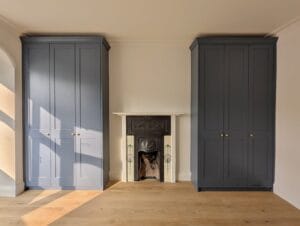
Alcove shelving in a period room has to finish somewhere, and the picture rail makes that choice visible. The shelves can stop at the underside of the rail, leaving the wall above them untouched, or they can climb past it to meet the cornice and use the full height of the recess. Both are sound joinery. They differ in how the room’s proportions read, how much storage you gain, how far an arm can reach, and how closely the new work has to copy the old.
The Rail as a Horizontal Line in the Room
In a Victorian or Edwardian room that has one, the picture rail sits some way below the cornice, and in some rooms it lines up with the top of the door architraves. The strip of wall between rail and cornice is the frieze, which could carry its own paint colour. Read from the floor up, the wall has layers: skirting, main wall, rail, frieze, cornice.
Any unit set into that wall either joins the line or breaks it. Where a chimney breast has a recess on either side, the point is plain. The rail crosses the face of the breast and runs into both recesses, so the pair of units meets the same line from two sides and the two tops have to agree. In a room with a flat wall and no breast, the same shelving is a single fitted run, and the rail meets it along its full width.
Not every period room has a rail. Bedrooms built up into the eaves and other low rooms could be left without one, because a rail needs a tall ceiling to carry the drop. Where there is no rail, the stopping height must come from elsewhere in the room, and the head of the nearest door architrave is the natural reference.
How Shelving That Stops at the Rail Reads
When the top panel of the unit reaches level with the underside of the rail, the rail’s line continues across the alcove in timber. The frieze stays clear, the cornice stays visible, and the room keeps the height it was built with. The shelving reads as furniture standing in a recess, with the original plasterwork left as the room’s upper edge.
That is the case for stopping at the rail in a room with a plain, quiet wall: nothing competes with the original plasterwork. The eye is not asked to read a new vertical mass beside the chimney breast, and the breast keeps its place as the focal point between the two alcoves.
The cost is the band left unused. In a tall room, that band can be deep enough for one or two more shelves, and a stopped unit leaves it empty. If the alcoves are for a modest book collection, a few boxes and a lamp, the loss may not matter. If they have to take a whole library, it will.
A stopped unit also leaves the rail in service as a rail. It stays fixed to the wall at full length, with nothing built against it.
How Shelving to the Ceiling Reads
A unit that runs to the ceiling removes the horizontal line from the alcove and replaces it with a vertical one. The recess stops reading as a gap with furniture in it and starts to read as part of the wall itself, a fitted library. In a tall room that suits the proportions, because the extra height carries the eye up to the cornice. In a room with an ordinary ceiling, the same unit can look heavy beside a narrow breast, so the room’s proportions determine whether it works.
Tip: Look at the rail’s cut ends beside a door or in a corner to see whether it is timber or moulded plaster. A timber rail can be cut and returned against a full-height unit; a plaster rail needs that cut agreed first.
A full-height unit has to resolve two things that a stopped unit avoids. The first is the rail itself. On the breast and the flat walls, the rail runs into the side of the unit and ends there; inside the recess, any rail on the back wall disappears behind the shelving. The second is the cornice. The top of the unit can carry a moulding that continues the room’s cornice, so the unit meets the ceiling in the same profile, or it can finish just beneath the cornice’s lowest edge with a deliberate shadow gap. The first suits a plain ceiling edge and the second suits a deep, decorated one.
The storage gain is real. Every shelf in that extra band is usable, and a closed upper section can take the things you want out of sight altogether. The gain only counts if the shelves are reachable, which is the next question.
Reach and Dust Over the Rail
Dust settles on horizontal surfaces, and a picture rail already has one on its top edge. A unit that stops at the rail adds a flat top panel at the same height, beyond eye level and beyond comfortable reach. It collects dust that nobody sees until the light catches it. A long-handled duster or a brush attachment on a vacuum cleaner takes care of it.
A ceiling-height unit has no exposed top panel, so that dusting job disappears. The highest surface becomes the top shelf, which is in view and within reach of an arm without a step. Books and boxes up there collect dust just as those below do, yet they are handled less often, so the dust is seldom disturbed.
Reach is the other practical limit. Shelves that start at the floor and end at the ceiling place the top shelf beyond a comfortable reach in a room with high ceilings. Two ways of handling it work well. One is to treat the top band as long-term storage and keep the everyday books and ornaments within easy reach lower down. The other is to fit doors across the top band, so the dust stays out and the shelves are opened only for things that rarely move. Either way, the unit is left to carry only what it was built for.
Warning: Never climb the shelves or stand on a chair to reach the top band. Use a firm, stable step, and if the unit ever rocks or moves away from the wall, empty it and have the carpenter check its wall fixings.
Matching the Victorian Detail
A period room carries a vocabulary of mouldings, and shelving that ignores it looks added on. Four details carry the match.
Architrave and face frame: The front edge of the unit, around the shelves, can be built as a frame with a bead or a stepped profile cut to echo the door architraves in the same room. The frame is what the eye reads first, so this is where the match matters most.
Plinth and skirting: The base of the unit sits on a plinth built to the height and profile of the existing skirting, so the skirting appears to continue beneath the new work.
Top moulding: On a stopped unit, the cap can take a moulding cut to the profile of the picture rail itself, which makes the shelving read as part of the same family of woodwork. On a full-height unit, the cap echoes the cornice.
Doors below the shelves: Where the unit has cupboards at the bottom, a shaker or beaded panel suits the period. A plain slab front is a cleaner choice for a modern room, and against a deep Victorian architrave it stands apart.
Hand painting finishes the work. The decorative surround is what makes a unit that stops at the rail look settled in the room, and it is also what stops a full-height unit reading as a bookcase that happens to be tall.
Choosing the Height
Weigh the choice room by room. These are the factors that settle it.
Stop at the rail when: The ceiling is of ordinary height, the frieze and cornice are intact and worth showing, the collection is modest, or you want the rail to keep a clear run across the room.
Go to the ceiling when: The room is tall, the books or boxes need every centimetre, you want a fitted-wall effect, and the cornice can be matched or met neatly.
Combine the two: open shelves up to the rail height with closed cupboards over them. The open shelves stop at the rail line; the doors above start at the same height, so the line still reads across the alcove; and the closed-top band keeps dust off what is stored there.
Whichever height you choose, the two alcoves either side of a breast should be treated as a pair with matching tops, so the chimney breast stays at the centre of the room.
A room needs only one stopping height, and the right one comes from reading the walls: the rail, the frieze, the cornice and the way the eye moves from the breast to the sides. The decision is easier once a designer has drawn both options to scale, because the difference in how they read shows plainly on a drawing and hardly at all in a description.
Frequently Asked Questions
Yes, on any stretch of rail that stays clear. A picture hook sits over the rail’s top lip, so the unit’s top panel must finish below the rail’s underside and never cover the lip. Inside a stopped alcove a hook can still be used, but the frame would then hang in front of the top shelf’s contents, so it is better placed on the breast or an adjoining wall.
A removed rail often leaves its old line on the wall as a row of filled nail holes or a ridge in the paint, which shows up when light falls across the wall at a low angle. Setting a stopped unit’s top to that line keeps the shelving at the height the room was proportioned around.
They can. Setting the cupboard tops level with the mantel shelf carries one line across the breast and both alcoves, and the open shelves then start from that line. Where the mantelpiece is deep or carved, the tops are often kept a little lower, so the mantel still reads as the main feature of the wall.
Light things that are handled a few times a year: spare lampshade boxes, board games, photograph albums and seasonal decorations. Keep heavy hardbacks between knee and shoulder height, and label the end of each box so it faces outwards, since you will be reading it from below.
A unit that stops at the rail can be made with a dead-level top, with any gap beneath the rail closed by a scribed strip, provided the rail itself was hung level. If the rail follows a sagging ceiling, its underside is out of level too, and the carpenter follows the rail. A full-height unit has its top edge cut to the ceiling or the cornice line on-site.
Painting the unit in the colour of the architraves, skirting and rail ties it into the woodwork, and a different colour lets it stand out as a feature. Where the frieze carries its own colour, matching the unit to the rail rather than to the frieze keeps its top edge from disappearing into the band above.
Note the rail height in both alcoves for a free design visit — the 3D drawings that follow can then show the shelving stopping at the rail and running to the ceiling, side by side. Humphries Cabinets serves London. Call 020 4538 7044.