Skip to content

You open the wardrobe to check your outfit and the mirror shows a strip of shirt and nothing of your shoes. Or the bedroom stays dim with the curtains wide open because a flat-fronted painted wardrobe faces the window. Or the glass on a mirrored door carries a fresh set of prints by the end of the week. Each of these points at a different choice between the two ways a fitted wardrobe can carry a mirror: a 1200 x 300 mm panel fixed to the inside of one door, or full mirrored doors across the front. The table below maps each symptom to its cause and to the option that answers it.
| What you notice | What causes it | Where it leads |
|---|---|---|
| Only part of your outfit is visible | A 1200 x 300 mm panel frames one vertical strip of you and nothing wider | Full doors give a wider view; the inside panel suits a check from a step back |
| The room feels dim | A matt painted front scatters daylight; glass sends it on in one direction | Full mirrored doors, if they face a window |
| Marks on the glass by midweek | Skin oil transfers on contact and shows against a flat, reflective surface | The inside panel, which is touched less |
| The wardrobe wall reads as a sheet of glass | The whole front changes from paint to mirror | The inside panel keeps the painted front |
| You cannot stand where the mirror needs you | The mirror lives on a door that has to swing open before it is any use | Full doors need no swing to be used |
How Each Mirror Sits in the Wardrobe
The inside panel is a fixed rectangle, 1200 mm tall and 300 mm wide, fitted to the back face of a hinged door. With the door shut, it is invisible, and the wardrobe front looks like any other run of painted panels. With the door open, it faces into the room, and you stand beside or in front of the open leaf to use it.
Full mirrored doors replace the wardrobe’s front face with glass. The mirror is there whether the door is open or shut, covers the whole leaf, and is used by standing in front of the closed door.
The carpenter chooses where on the door the inside panel goes, and that choice matters. Set high, the 1200 mm height runs from the top of your head to somewhere around the hips. Set low, it runs from the chest down to the shoes. A face-and-torso check and a shoes-and-hem check are two different positions, and the height is decided once, at the design stage.
Using Each One Every Morning
Think about the order of the morning. You reach in for a shirt, you want to see how it sits, and you look. With the inside panel, the door you opened is the one carrying the mirror, so the check happens with the door still open and you standing in the leaf’s swing, the clothes at your shoulder. That suits a quick glance, and it suits a wardrobe with room for the door to swing wide.
The 300 mm width shows one slice at a time. To see a shoulder line, a hemline and the back of a collar, you turn as you look. A full mirrored door has no such limit: you step back, take in the whole figure in one frame, and the view is independent of any open door.
The trade is floor space. The inside panel needs a standing zone beside an open door. A full mirrored door needs a zone far enough back to see yourself, and the depth of the room in front of the wardrobe wall decides how much of you the glass can take in.
Light and Brightness in the Room
Glass with a reflective backing returns the light that reaches it along a single angled path. A painted front scatters light in all directions and reflects only a portion of it. That difference is how a mirrored wall can lift a room.
The lift depends on what the glass faces. A mirrored front opposite a window carries daylight across to the far wall and into the corners. A mirrored front set on a wall, with nothing bright opposite, reflects the room’s own furniture and adds little to the light.
The inside panel changes none of this when the door is shut, because the wardrobe front remains a painted surface. Open the door, and the panel reflects whatever it is turned towards for as long as the door stays open.
If the wardrobe wall sits opposite the only window, full doors are a real option for brightness. If the wardrobe stands on the window wall itself, or the room already gets plenty of daylight, the extra reflection earns little, and the inside panel keeps the front calmer.
Fingerprints, Smears and Cleaning
On a painted door, a print can leave a faint, dull patch, but the surface does not reflect anything, so there is little for the mark to interrupt. On glass, the whole surface is a reflection, and any smear sits across the picture of you and the room.
Where you touch decides how much you see. A full mirrored door is a door you handle, so the prints gather at hand height around wherever you grip it. A door at child height collects prints from a child, and loose sleeves leave brush marks along the lower third of the glass.
The inside panel meets hands less. You handle the outside face of the door to open it, and the mirror on the back face is touched mainly when you lean on it, reach past it for a hanger, or swing something against it, such as a necklace or a belt buckle.
Both come clean with a cloth. The difference is how soon the prints return, which depends on how many hands pass over the glass in a week.
Fitting Each Option to a Painted Wardrobe
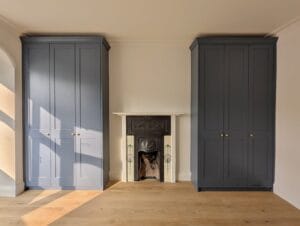
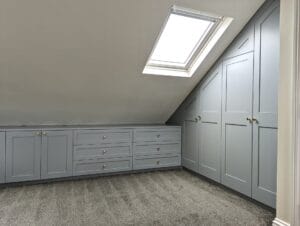
Fitted wardrobes are made in the workshop and hand-painted on site once the carpenters have finished. The inside panel sits on the back of a door that is itself painted on the face, so the painted look carries across the whole run: the shaker lines, the colour that matches the architrave, the shared finish. The mirror stays out of sight until it is needed.
Full mirrored doors take over the face. The paint then lives on the carcass, the surrounds and any frame around the glass, and the large central panels are glass. The glass picks up whatever colour is across the room, so the opposite wall shows up in your wardrobe front.
Paint can be touched up at a door edge. A scratch in glass cannot be touched up the same way. Where bags and cases brush the front as you pass, the painted face with an inside panel carries less risk of a visible mark.
A glass panel adds weight to a door, so the hinge choice is part of the planning when a mirror goes on a hinged leaf. A 1200 x 300 mm panel loads a door less than a full-height sheet of glass.
Choosing Between Them
Choose the inside panel when the wardrobe front should stay painted, when the room already has light, or when the wardrobe stands where the door has space to swing. Choose full mirrored doors when the room is dim, the glass faces a window, and you want to see your whole figure without opening anything.
Neither choice rules out the other. A run of four doors can carry one full mirrored door and an inside panel on a neighbouring leaf, which gives a full-length view and a hidden dressing mirror in the same wardrobe.
A mirror earns its place by being used every day without becoming a nuisance. Decide where you will stand, what the glass will face and how many hands will touch it, and the choice nearly makes itself.
Frequently Asked Questions
Yes, if the door can swing far enough. A standard concealed hinge leaves the open leaf, and the mirror on it, angled across the wardrobe front, so a wide-opening hinge lets the leaf fold further back and turn the glass towards you. Check the arc against the bed edge before choosing the door.
The leaf nearest the window, where it can be opened so that daylight falls on you as you look. A mirror on a door with the window behind you puts you in silhouette, and the glass then shows the bright window more clearly than your clothes.
Not in a way you could use. A sliding door never swings round to face you, and its back face stays inside the wardrobe behind the door it overlaps, so on a sliding run the glass goes on the front, as a full mirrored sliding door.
No. The panel can be fixed with its edges ground and polished smooth, so it sits flat on the door with no frame. On a shaker door, a slim bead around the glass can echo the door’s own mouldings if a framed look is wanted.
It can if the panel is centred between their eye levels, though the shorter person then sees less of their shoes and the taller one less of their head. When two people share a wardrobe and the height difference between them is large, a full mirrored door serves both.
Yes. The panel takes the middle of the door’s back face, so a tie rail, belt hooks or a shallow rack has to go on a different leaf or in the margin above or below the glass. Decide which door carries which before the drawings are made.
Decide which leaf you would dress in front of before a free design visit — the designer can then place a full mirrored door or a 1200 x 300 mm inside panel where the room gives you space to stand back. Humphries Cabinets serves London. Call 020 4538 7044.