Skip to content

Before you order a cover for a child’s room, kneel beside the radiator so your eyes are level with your child’s and look at three things: the hot metal face, the edges and gaps a small hand can reach, and anything within climbing distance, especially a window. A well-made cover deals with the first two. The third is where a badly planned cover can leave a room worse off, because a solid box fixed firmly to the wall is exactly the kind of surface a child likes to stand on. Work through the checks in order, understand how the front of a cover stays cool enough to touch, and know where the job passes to a heating engineer.
What a Cover Changes Around a Hot Radiator
A steel panel radiator operating at the top of its range can reach a casing temperature close to 80°C, which is too hot for anyone to keep a hand on. A cover places a panel of timber or MDF between the child and that face, and it changes three specific things.
Direct contact with hot metal: A toddler pulling up to stand grabs whatever is at hand height. With a cover in place, the hand lands on a painted or varnished front that sits forward of the radiator, with an air gap between the two.
Fins and sharp edges: On a double-panel radiator, thin, folded metal convector fins sit between the panels. Where the top has no grille, small fingers can reach down into them, and the pressed-steel corners on some radiators are sharp. A made-to-measure cover puts a grille across the top and boards across the sides, and replaces those corners with rounded, sanded ones.
The top surface: A bare radiator top is narrow and hot, so nobody uses it as a place to stand. A cover replaces it with a wider, firmer surface. That one change is why the top of a cover in a child’s room needs as much thought as the front.
How the Front Stays Cool Enough to Touch
A radiator warms a room mainly by moving air. Cool air is drawn in at the bottom, rises past the hot panel, and leaves at the top. A cover that keeps this current running puts it to work: the air moving through the gap behind the front carries heat upwards and out before much of it can soak into the front panel.
The material helps too. Timber and MDF pass heat slowly, so the outer face of a painted or varnished front warms gradually and stays cooler than the steel behind it. The grille openings let warm air and some radiant heat through to the room, so the radiator keeps doing its job.
This only holds while air can move. A cover set tight to the floor, or a solid top close over the panel, stalls the current, and heat soaks into the timber until the front and top feel hot rather than warm. A top you cannot rest your palm on after an hour of heating means the air path is blocked somewhere.
Steps to Plan a Cover for a Child’s Room
These six steps take you from the first look at the radiator to living with the finished cover.
- Look at the room from your child’s height. Note the bed, chairs, shelves, and anything else within a short shuffle of the radiator, and whether the radiator sits under a window. Write it down; it shapes every later decision.
- Record what the radiator is and where it sits. Single or double panel, column style, the height from floor to top, and which wall it is on. A designer can draw a cover around those details at the design visit.
- Decide what the top is for before you choose a style. On a side wall away from windows, a flat top can hold a lamp or books. Under an opening window, plan a top that discourages standing, such as a sloping top that leaves no flat ledge, and keep the cover top clear of cushions and display pieces.
- Choose a front with real openings and smooth edges. The grille pattern matters less than how much of the front is open. Ask for rounded corners and edges sanded smooth, then sealed with paint or varnish so no raw fibres are left to splinter. Hand-painted fronts and varnished oak or walnut both give a sealed, wipeable surface.
- Ask how it is fixed and see it drawn. A cover for a child’s room should be fixed to the wall so it cannot tip or be pulled forward, with the fixings inside the cover where small hands cannot reach them. Ask to see drawings that show the gaps around the radiator and the shape of the top before anything is built.
- Check it once the heating has run. Feel the front and the top after the room has warmed up. If the top is hot, look for a blocked air path: a rug over the gap at the bottom, a toy pushed against the grille, or clothes left on the top. Keep the bottom and the grille clear every day.
Warning: Do not take a radiator off the wall, loosen its valves or move pipework to fit a cover. Draining, removing, refitting or relocating a radiator is a heating engineer’s job; the cover is built around the radiator where it already sits.
Keeping the Cover From Becoming a Step Under a Window
Climbing arrives in sudden jumps, and a toddler can reach a surface this week that was out of reach last week. A firm, wall-fixed cover takes their weight better than a wobbly chair. That stability is a good thing on a side wall and a problem under a window.
Keep low furniture, including a radiator cover, away from windows a child can open, even on a ground floor. If the radiator is already under the window, the cover cannot be moved, so the planning shifts to the top and to the window itself:
- Use a sloping or narrow top so there is no flat surface to stand on.
- Keep beds, chairs and shelves away from the cover, so it cannot become the second step of a route to the sill.
- Keep window restrictors or locks engaged, and never disable them because the window feels stuffy.
- Avoid adding a shelf or cushion on the cover in that room.
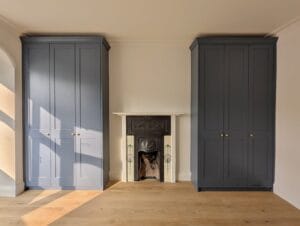
Joined-up furniture deserves a second look. In a room with a chimney breast, a cover is sometimes built into the alcove units beside it, so its top lines up with the cupboard tops on either side. In a room without one, the same cover can be part of a fitted run along a flat wall. In both layouts, check that the combined tops do not form a continuous low route that ends at a window.
Tip: If you fit key-operated window locks in a child’s room, keep the key somewhere every adult in the house can find, close to the window but out of a child’s reach, so the window can still be opened in a fire.
What a Cover Leaves Unchanged
A cover changes what a child touches, and leaves the heat source behind it as it was. The water inside the panel is just as hot as before, and the air leaving the top is warm. If the grille openings are wide enough for small fingers, those fingers can still reach towards the panel behind, so pick a pattern with openings sized for the child’s age.
The radiator, its valves and its pipework behave exactly as they did before the cover went on. A dripping valve or a cold patch on the panel is still a heating problem, and the cover only makes it harder to spot, so look behind the grille from time to time. A poorly vented cover will also cost the room some warmth, which is another reason the open front and clear top matter.
Finally, no cover makes a radiator safe on its own. It lowers the chance of a hand landing on hot steel and removes sharp metal from reach. Supervision, a sensible furniture layout, and working window restrictors still do the rest.
When to Call a Heating Engineer or a Cabinet Maker
Call a heating engineer for anything that involves the radiator itself: a leak, a valve that will not turn, a radiator that needs to come off the wall for decorating, or a wish to move or replace it. That work happens before the cover is measured, because the cover is drawn around the radiator in its final position.
Call a cabinet maker for the cover: the design visit, the measuring, the drawings, the fixing to the wall and the finish. Bring your notes from the first three steps to the visit, including which way the window opens and where the bed will go, so the top and front can be designed around the child who will use the room.
A radiator cover in a child’s room earns its place when it is planned around three questions at once: what the hand touches, where the air goes, and what the top invites a child to do. Answer all three on paper before anything is cut, and the cover becomes a calm, finished part of the room.
Frequently Asked Questions
Check the heater’s own instructions first. Some electric radiators and panel heaters carry a clear instruction that they must not be covered, and an electric towel rail or heater may also have its own clearances. If the paperwork says do not cover, choose a different fix and ask an electrician about the heater itself.
It can. A thermostatic radiator valve senses the air around its head and, if the air inside a cover is warmer than the room, it can shut the radiator down early and leave the room cool. Keep the valve head outside the cover line, or ask a heating engineer about a remote-sensing valve head.
A perforated or mesh metal guard lets more air through than a solid-fronted cabinet, so the radiator loses less output. The weak point is the cut metal: unless the edges are rolled or folded back, a sharp-edged mesh can graze a child’s skin. Timber covers avoid that edge problem once they are sanded and sealed.
A low surface temperature radiator has its heating element and pipework separated from an outer casing, so no part of the surface goes above 43°C, even if the thermostat fails. It replaces the radiator rather than covering it, so it is a heating engineer’s job and a decision to make before any cover is designed.
Yes, if something else becomes the first step. Young children can drag a toy box or a small stool across the floor to reach a higher surface. Wherever the cover sits, keep movable boxes and stools away from it so it never becomes part of a climbing route.
On some made-to-measure covers the inside is drawn about 30mm taller and 20mm wider than the radiator, so warm air has room to rise and turn out through the top grille. Your own radiator’s size and the room’s layout set the final figures, which should appear on the drawings before the cover is made.
Have a child’s room radiator cover designed around the room — a wall-fixed, ventilated cover drawn around your radiator, your window and your child’s reach. Humphries Cabinets serves London. Call 020 4538 7044.