Skip to content

The wall you want for a fitted wardrobe has a radiator on it, and the quickest plan on paper is to run the doors straight across and forget it is there. A wardrobe can be built over a radiator, but a sealed one changes three things at once: where the heat goes, whether you can still reach the controls, and how the air behaves against the wall behind. Each of those shows up as a symptom you notice weeks after the carpenters leave. Each row in the table below starts from one of those symptoms and names the part of the build responsible, so the run can be planned to avoid it.
| What you notice | Why the wardrobe causes it |
|---|---|
| Clothes on one side feel warm and dry, and leather goes stiff | Heat collects inside the closed wardrobe and soaks into whatever hangs nearest the radiator |
| The room takes longer to warm up although the radiator is hot | Much of the rising warm air is trapped inside the carcass and never reaches the room |
| You have to empty a shelf to turn the heating up or down | The valve end of the radiator sits behind the wardrobe’s side panel |
| Clothes at the back smell stale after a cold spell | Air trapped behind the carcass cools when the heating goes off and leaves moisture on the wall |
| You cannot turn, adjust or service the radiator | The valves and pipe joints are behind a fixed panel |
| A door on the radiator side rubs or sits proud of its neighbour | One face of the panel has dried faster than the other, and the board has bowed |
How a Radiator Behaves Inside a Closed Wardrobe
Stand beside a radiator and two kinds of warmth reach you. One you feel on your face straight from the hot metal; the other is air that has climbed up the panel and its fins, drifted across the ceiling and come back down the room. The second carries most of the heat.
A closed wardrobe catches both. The doors take the warmth that would have reached your face, and the climbing air hits the underside of the first shelf and pools there, so the hanging space on that side turns into an airing cupboard while the bedroom stays cool. The radiator is still hot; its heat is simply ending up among the clothes.
The furniture pays for it too. The face of a door nearest the radiator stays warm and dry during the winter, while its outer face sits in room air, so the two faces shrink by different amounts, causing the door to bow or a joint to open slightly. Pale painted finishes on the warm side can also change colour over a few winters.
Valve Access and the Controls You Still Need
A radiator still needs to be reached once the wardrobe is in. It has a valve at each end: one that you turn to set the heat (a thermostatic head on modern systems), and a lockshield valve at the other end that a heating engineer sets to balance the system. There are pipe joints under both, and the radiator itself has to be removed from the wall for some heating work.
The valve you turn is the part a wardrobe gets in the way of first. It is the control you reach for whenever the bedroom is too warm or too cold, and it sits low down at one end of the radiator. Behind a door it means opening the wardrobe and moving whatever is on that shelf; behind a fixed panel it means not adjusting it at all. Note which end it is on and its height from the floor before the design visit, because that one position decides where the nearest side panel can stop.
Any plan for a wardrobe on a radiator wall needs a clear answer to one question: how does a hand reach each valve without taking a panel off? A removable panel held on screws is an answer on paper, but a valve behind screws tends to go untouched, and a slow drip from a joint can go unseen for months.
Warning: Leave the valves and pipe joints alone while planning the run. If the radiator must move, a heating engineer drains the system, refits it and checks every new joint for leaks before the carpenter measures.
Damp Behind a Boxed-In Radiator
The damp risk arrives when the heating goes off. A boxed-in radiator spends the evening heating the cavity behind the wardrobe, then cools overnight, and the air trapped in that cavity cools with it against the wall. Any moisture it carries can settle on the wall, and the back of the carcass, and the first sign can be a stale smell in the clothes before any mark shows.
A radiator under a window is often on an outside wall, which makes that cavity the coldest surface in the room once the heating is off; on an internal wall the effect is milder. Either way, the cure is the plan that follows: let the radiator heat the room, not the cavity.
Plan the Run Around the Radiator
The simplest fix leaves the radiator open and builds the wardrobe on either side of it. A run can stop short of the radiator, with an end panel set back from the valve so a hand can reach it from the front without opening a door. Or the storage can be split, with a tall section on each side and the radiator wall between them left open.
The space over the radiator does not have to be wasted. Open shelves set well clear of the radiator top can carry books, baskets, or ornaments, with gaps at the front and back so warm air rises past them into the room. Doors over that section are what cause the trouble; open shelves let the heat out.
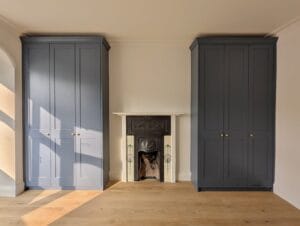
Room shape decides how this looks. Where a chimney breast creates an alcove on each side of the room, the wardrobe can take one alcove and leave the radiator’s alcove open, so the split reads as part of the room’s own layout. On a plain wall, the gap is drawn as a single continuous run, with the two tall sections and the shelves between them sharing a single cornice line.
Tip: Before the design visit, measure from each end of the radiator to the nearest corner or door frame. Those two numbers decide whether each side of a split run can still take long hanging or only double hanging.
Leave a Ventilated Section
Some rooms have only one wall that can take a wardrobe, and splitting the run would leave sections too narrow to use. The next option is to bring the radiator inside the line of the wardrobe and treat that bay differently from the rest.
The radiator bay is built as a ventilated cover. It needs three openings to work: a clear gap at the bottom so cool air can be drawn in, a front with a real amount of open area (a grille, slats or fretwork), and a top that lets warm air out into the room. The grille front can be painted to match the wardrobe doors, so the bay reads as part of the run.
What the bay must not do is hold clothes. Nothing hangs over the radiator, and nothing is shelved inside the cover. The tall sections on either side are closed off from the radiator bay by full-height panels, so warm air rises into the room rather than sideways into the hanging space. The valve end of the bay gets an opening wide enough for a hand to turn the head, drawn on the front elevation before the grille is made.
A ventilated bay costs as much as the width of the radiator in storage. In return, the run looks continuous, and the radiator keeps heating the room.
Have the Radiator Moved Before the Wardrobe Is Fitted
When the radiator wall is the only sensible place for full-height storage across its whole width, moving the radiator is the answer that frees the wall. A heating engineer drains down the system, takes the radiator off the wall, fixes it in its new position, alters the pipework to suit and refills and tests everything.
Order matters. The radiator is moved, the pipework is settled, and any plaster is made good before anyone measures for the wardrobe, because the wardrobe is drawn around the wall as it will be. Ask the heating engineer where the new flow and return pipes will run, so you know whether anything crosses the wall the wardrobe will cover.
Where to put the radiator is a heating decision. A short wall beside the door, a space under a window on another wall, or a different radiator shape altogether are all options for the heating engineer to weigh against the size of the room.
Choosing Between the Options
Start with the wall. If the radiator sits near one end, stopping the run short of it costs little storage and keeps everything simple. If it sits in the middle, a split run with open shelves between suits a room with enough width for two useful tall sections. If neither side would be wide enough to hang clothes, the ventilated bay keeps the run whole. If you need every centimetre of that wall closed in for clothes, plan to have the radiator moved, and book the heating engineer before the design visit.
Whichever you choose, the radiator either stays in room air with its valves in reach, or it leaves the wall. A plan that boxes it in and hopes for the best is the one that ends with warm jumpers and a cold room.
Frequently Asked Questions
Yes, and it is the simplest version of the split run. Leave a gap between the side panel and the end of the radiator, and check where the pipes come up through the floor at that end, because the pipe position, not the radiator panel, decides how close the side panel can sit.
It is worth asking about. Swapping a wide, low radiator for a tall, narrow one hands most of that wall back to the wardrobe, but the new radiator still has to heat the room, so a heating engineer works out its size and position before the wardrobe is drawn around it.
The bleed valve is the small square fitting in the top corner of the radiator, at one end. The bleed screw has a 5mm square head that a standard radiator key fits, though some older radiators take a different key. If the radiator stays within the run, make sure that top corner sits outside any fixed panel.
Keep leather shoes, belts and bags well away from the warm side. Direct heat dries leather out too fast, and it can stiffen and crack. Wet shoes, in particular, should be dried at room temperature, stuffed with newspaper, and returned to the wardrobe only once they are dry.
Plan the section nearest the radiator for things that cope with warmth, such as folded towels or bedding, and keep wool and silk in the sections furthest from it. Fill the warm side last, so its shelves stay part-empty and air can move through them.
Quite possibly. In a house with suspended timber floors, the heating engineer can lift the floorboards to access the pipework and reroute it to the new radiator position. Plan for that before carpets or skirting are finished in the room.
Show the designer which end of the radiator you turn at a free design visit — the wardrobe run is then planned with a clear gap or a vented bay, so the bedroom keeps its heat and the valve is never trapped behind a panel. Humphries Cabinets serves London. Call 020 4538 7044.