Skip to content

A shelf in a fitted wardrobe is joined into the carcass for good, rests on small pins that move to a new hole whenever the contents change, or, in a section built for heavy files, hangs on clips in a metal strip. The choice looks minor on a drawing, yet it decides how stiff the unit feels, how a long shelf behaves under a stack of knitwear, and whether the layout can follow you through ten years of changing clothes, boxes and bags. Construction comes first, then strength, span and flexibility, and finally where each type belongs.
How Each Type of Shelf Is Held
Fixed shelves: A fixed shelf goes in while the carcass is being assembled, held between the side panels by a groove cut across each panel or by cam fittings, confirmat screws or dowels. From then on, it is as much a part of the box as the top or the base.
Adjustable shelves: An adjustable shelf rests on shelf pins pushed into vertical columns of drilled holes in each side panel, front and back. Lift the shelf, move the four pins to another row of holes, lower the shelf back, and the job is done in a minute without tools.
That difference reaches beyond the shelf itself. One fixed shelf is one more part that holds the box together, while a pinned shelf leans on the side panels for every kilo it carries, giving them nothing back.
Strength and Stiffness
Picture a tall carcass with no shelves in it: two long side panels joined only at the top and the base, free to flex in the middle. A fixed shelf at mid-height pins them together at that point, so the box resists being pushed out of square as it is carried up the stairs, stood in place and loaded. In a full-height wardrobe, that mid-point is where the side panels are longest and most in need of it.
An adjustable shelf sits on its supports and pins nothing together, so it adds almost nothing to that stiffness. A carcass full of adjustable shelves can still be perfectly rigid, but the rigidity then comes from the back panel, the top and base, the fixings into the wall and any fixed shelves placed on purpose.
Accuracy shows up differently too. A fixed shelf cut slightly long or short is clamped between the sides as the carcass is screwed together, which can drag it out of square. A loose shelf that is slightly out shows the error later, as a shelf that sticks or leaves a gap whenever it is moved to a new height.
The table below lines up how the two behave.
| Factor | Fixed shelf | Adjustable shelf |
|---|---|---|
| Joined to the carcass | Yes, permanently | No, rests on pins |
| Adds stiffness to the sides | Yes | Little or none |
| Height can change later | No | Yes |
| Long, heavy loads | Sound joint carries them | Keep the span short |
| Best use | Dividing tall sections, topping drawer stacks | Folded clothes, boxes, bags that change |
Span, Sag and Board Thickness
Sag happens to fixed and adjustable shelves alike; what decides it is how far the board reaches and what it carries. A shelf is a beam supported at its ends; the greater the distance between supports, the more it bends under the same load. An 18 mm chipboard or MDF shelf holding folded clothes stays flat up to about 800 mm between supports; beyond that it wants a support in the middle or a strip of solid timber glued along its front edge. Books and files are denser than folded clothes, so a shelf meant for them needs a shorter span.
Tip: Write down the heaviest thing each shelf will hold, such as a stack of folded knitwear or a row of storage boxes, and tell the designer at the visit. Heavy loads decide which shelves are fixed and which get a centre support.
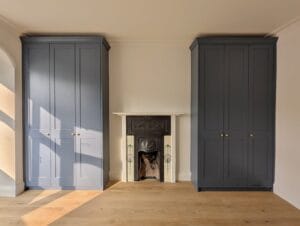
This is where the room shapes the plan. A wardrobe built into an alcove beside a chimney breast has a short gap between its sides, so a plain adjustable shelf stays flat. Along a flat wall with no chimney breast, the bay widths are a free choice, and a wide bay between two dividers can pass that comfortable span unless it is drawn narrower. The remedy is a fixed shelf in the middle, a vertical divider that halves the span, or a stiffening lip on the front edge.
Pin position matters as well. A loose shelf rests on four small points, so the four holes at each height must sit at exactly the same level, and each column has to run plumb so that every height in the section lines up consistently.
Flexibility Over the Years
Storage needs change faster than a wardrobe does. The shelf that held jumpers in the first year can be holding a baby’s clothes in the fifth and a teenager’s trainers in the tenth. Adjustable shelves meet that change without any work on the carcass: the pins move, and the clear height between shelves moves with them.
Fixed shelves lock the layout. That suits a section whose use is settled, such as the shelf above a hanging rail or the platform on top of a drawer stack, but it leaves a gap that is too tall or too short if habits shift. A gap that is too tall wastes height, and one that is too short stops a box or a boot from fitting at all.
Where Adjustable Shelving Earns Its Place in Loft Units
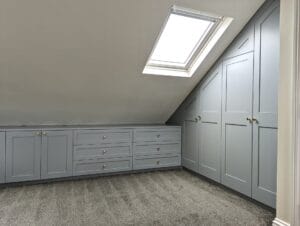
Loft wardrobes and loft eave units are built with adjustable shelving, and the room explains why. A loft bedroom has angled ceilings and low eaves, so the units are shaped to the slope and the usable height changes along the run. Adjustable shelves let the spacing follow whatever the sloped section allows, and they let the stack be reset later for suitcases, large boxes, or folded clothes. An eave base can be fitted with shelves for folded clothes or left open for luggage, and pinned positions keep that choice from being final.
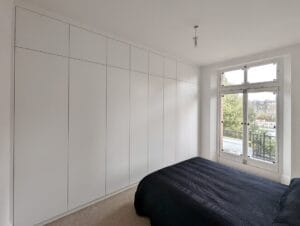
A loft with full-height walls does not need the same compromise, and a wardrobe on a straight wall can lean more on fixed shelves where the layout is certain.
Four Questions That Decide Each Shelf
Taking the wardrobe one section at a time gives a clearer answer than choosing a single system for the whole unit. Four questions settle each one.
How heavy is the load? A fixed shelf hands its load to the side panels along the whole joint. A loose shelf hands the same load to four pins, each in a small drilled hole, so a dense stack of knitwear or boxed shoes is better on a fixed shelf or a short span.
How wide is the section? Narrow sections stay flat on pins. Wide ones need a fixed shelf, a divider or a stiffened front edge, as the span limit for an 18 mm board makes clear.
How settled is the use? A section to hold folded shirts for as long as you live in the house can be built. A section that holds whatever does not fit elsewhere belongs on pins.
Does the ceiling or wall change the height? Where the roof slopes, the clear height changes along the run, and pinned shelves can be set to suit each bay. Where the walls are full-height, the heights can be fixed once and left as is.
Mixing Both in One Wardrobe
The practical answer is both. A fixed shelf at each height that will never change keeps the tall sections square, and every other shelf sits on pins for the storage that will. Fixed shelves carry the structure, adjustable shelves carry the variety, and neither is asked to do the other’s job.
A simple test: Fix the shelf if the section is tall and its use is settled. Put it on pins if the contents change, if the gap has to follow a sloped ceiling, or if you cannot say today what will sit there in five years.
Settling the Layout Before Production
The interior of a fitted wardrobe is planned around your own clothes at the design visit, and the 3D drawings show the shelf positions before anything is cut. That is the moment to decide which shelves are fixed. Changing a fixed shelf after the carcass is built and painted is a carpentry job, while moving a pinned shelf takes a minute, so the decision that is hard to reverse belongs at the drawing stage.
A good interior is one that still works when the contents do not stay the same. Fix what is certain, leave the rest on pins, and the wardrobe keeps pace with the household.
Frequently Asked Questions
In steps of 32 mm, because the pin holes are drilled in a column at that spacing. Each shelf is also cut 2 to 3 mm short of the gap between the sides, enough for it to tilt out of the opening without catching the painted panels.
Not in any way that matters to the carcass: each hole is about 5 mm across. What can wear is the hole itself, when a pin is pulled out and pushed back many times in chipboard, so a shelf that will be moved often can sit on pins that fit into a metal sleeve set in the panel.
Yes. A common pairing puts a fixed shelf directly over a hanging rail, so the shelf ties the sides together at the height where a rail full of clothes pulls on them, and pinned shelves above it take boxes and bags.
For a section given over to books or files, a slotted metal upright can be screwed to each side panel, with clips that hook into the slots at any height. The load then goes into the upright’s row of screws, not four small holes, and the clips move as easily as pins.
They can if the shelf is loose in its gap or the four pins are not level with each other. Even a millimetre out leaves the shelf resting on two opposite corners, so it tips when you press on the other two. Pins with a soft plastic or rubber cap stop the click.
The designer proposes it at the design visit, based on your list of belongings and the width of each section. The 3D drawing shows every shelf position, so you can ask for a fixed shelf to be made adjustable before production starts.
List what each section will hold, from folded knitwear to boxed files — the designer then marks every shelf on the drawing as fixed or pinned to match the weight it will carry. Humphries Cabinets serves London. Call 020 4538 7044.