Skip to content
A fixed shoe shelf runs back to the wardrobe’s rear panel, and that depth is both its strength and its flaw. The front pair is easy to grab, while the pair behind it sits in shadow, out of reach, and gets forgotten for a season. Two fittings deal with that depth in opposite ways: a fixed shelf accepts it and packs pairs in, and a pull-out tray on drawer runners slides the whole shelf out to meet you. Each changes how many pairs fit, how easily you reach them and what can go wrong over the years.
How a Pull-Out Tray Brings the Back Row Forward
A shoe tray is a shallow shelf, with or without a low front lip, mounted on telescopic drawer runners. The runners fix to the inside faces of the side panels (or to a divider), and the tray carries its load on the runners, not on the carcass floor. Pull the front and the tray travels out of the wardrobe, so both rows of shoes come into the room with it.
How far the tray travels depends on the runner. A full-extension runner carries the whole tray clear of the carcass, so the back row sits in the open and can be lifted out from above. A partial-extension runner leaves the rear of the tray inside the wardrobe, and the back pair is still within reach. For shoes, full extension is the one to ask for.
A tray also needs space that a fixed shelf does not. The runners take a slice of width on each side, and the tray’s base and front lip take a few millimetres of height. These small losses add up across a section, which is why a tray layout holds fewer pairs than a fixed one of the same size.
How a Fixed Shoe Shelf Holds Its Pairs
A fixed shelf is a board housed or screwed into the side panels. It has no moving parts, so it takes the full width between the panels and wastes almost no height. The board can be thin, the gap above it can match the shoes it carries, and nothing sits between the pairs and the carcass except the shelf itself.
The cost is access. Pairs go in two rows, front and back, and only the front row is within easy reach. To get at the back row, you lift out the front pair first or lean in and feel for the shoe you want. Pairs pushed to the back stay there, while the front row gets worn on rotation.
A fixed shelf also takes awkward shapes without fuss, such as a boot with a wide shaft or a walking shoe with a deep tread. Nothing at the sides restricts them, and the gap above the shelf can be cut to the tallest item on it.
How Many Pairs Each Layout Holds
Capacity comes down to three measurements: the width of the section, the depth of the carcass, and the height available. A fixed shelf uses all three. A tray gives up a little width to its runners, and a little height to its base, and every tray level needs a gap to itself with room above the shoes to lift them out.
For flat shoes such as trainers, loafers and pumps, a clear gap of around 150 mm per level suits many pairs, and chunky trainers can need more. A fixed shelf can sit that close because nothing has to move, so a section of fixed shelves holds more levels. A tray section loses a level or two across the same height, depending on the thickness of the tray base and the depth of the lip.
Two things narrow the gap between the layouts. Pairs that would be forgotten at the back of a fixed shelf stay in rotation on a tray, so the pairs you own are the pairs you wear. And a carcass that is too deep to reach into comfortably becomes useful again once the whole shelf slides out.
Tip: Stand your tallest ankle boots on a table and measure to the top of the shaft, then add a hand’s depth for lifting. Give that figure to the designer so one level is cut around them.
With a collection of mostly flat shoes, a fixed layout holds more pairs. When boots and bulky pairs make up a large share, the tall items set the overall height, and the two layouts come closer together.
Which Layout Lets You Reach Every Pair
Access is where trays win. A tray in the lower part of the wardrobe is reached by crouching and pulling, making the whole shelf visible from above. Nothing needs to be shifted to see what is behind it.
A fixed shelf gives you the front row at a glance and the back row with effort. Set between hip and shoulder height, it is easy enough to reach into for the shoes worn every week. Placed at floor level, the same shelf is awkward, because you have to kneel and reach into the dark.
The split follows from that. Shoes in daily rotation go wherever your hand reaches most easily, and seasonal pairs, such as sandals in winter or boots in summer, can sit on fixed shelves where the back row matters less. Putting every level on runners adds moving parts for pairs that come out twice a year.
What Separates a Good Runner From a Poor One
The runner decides whether a tray stays pleasant to use for years. Three features matter.
Extension: Full extension brings the back row out. A runner that stops short leaves part of the tray inside, defeating part of its purpose.
Bearing type: Runners with ball bearings track straight when a tray is pulled from one corner, whereas looser roller runners can rack and stick.
Damping: A soft-close runner catches the tray near the end of its travel and draws it in gently, so the pairs are not jolted forward against the lip. Every drawer and tray in these wardrobes runs on soft-close runners as standard.
Where Each Suits a Run of Wardrobes
The two fittings do different jobs in different parts of a run. The bottom of a wardrobe, below knee height, is where trays earn their place: a crouching reach to a sliding shelf is easier than a kneeling reach into a deep compartment. At middle height, between the knee and the shoulder, a fixed shelf is reached comfortably with no runner at all, so a tray there requires little effort.
Section width matters too. Narrow sections suit trays because a narrow tray has little width to twist across when pulled from one corner. Wide sections are better broken up with a divider.
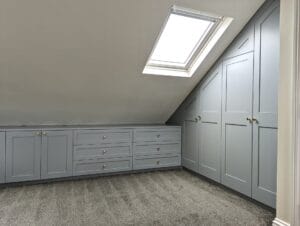
Loft wardrobes follow the roofline, and the low end of a sloping run may be too low for a fixed shelf to be reachable. A tray in that low end slides out into the room, bringing the shoes to a height where they can be seen and lifted out. In a room with full-height walls there is no such limit, and the choice can follow habit alone.
Settling the Split at the Design Visit
Decide the split by sorting what you own into three groups: pairs worn weekly, pairs worn a few times a season, and tall or bulky pairs. Weekly pairs go on trays at a comfortable height, seasonal pairs on fixed shelves, and the tall pairs on a fixed shelf with a gap cut to suit.
The 3D drawings show the result before anything is made, so the height of each level can be changed on paper. Moving a tray up a level in a drawing takes minutes, while the same change after fitting means refixing the runners and filling the old holes.
Neither fitting is right for every pair. A wardrobe that mixes both, with the choice made shelf by shelf from what each shelf will hold, gives every pair a place and keeps each one within reach.
Frequently Asked Questions
Ankle boots can, on a level given its own taller gap. Knee-high boots stand better on a fixed shelf or the wardrobe floor, with a boot shaper inside each shaft, because a tray level tall enough for them wastes height across the whole section.
A low upstand along the rear edge and a lip at the front. Without it, a heel can drop off the back as the tray is pushed shut, falling onto the level below.
Lay a mat cut to the size of the tray base. It catches the grit that falls from soles and lifts out to be shaken outside, so the tray itself needs only an occasional wipe.
Rarely. Boxes stack two or three high on a fixed shelf, and a label on each box end tells you what is inside, which does the job a tray does for loose pairs. A tray carries boxes one layer high, so it holds fewer of them.
Yes. Tilting the shelf forward, with a rail along its front edge to stop the pairs sliding off, shows the whole of each shoe at a glance. The slope eats into the height of the level beneath, so it suits a short run of pairs on display.
Yes, set at a height the child can reach while standing. A tall front lip holds small shoes in place when the tray is pulled, and fixed shelves higher up take the pairs kept for best or waiting to be passed on.
Gather your tallest boots and your flattest pumps for a free design visit — so the tray heights and shelf gaps are set around the pairs you really own. Humphries Cabinets serves London. Call 020 4538 7044.