Skip to content

A fitted wardrobe does not create damp on its own. Condensation forms when warm, moist room air meets a cold surface and cannot circulate away. A wardrobe pressed flat against a cold external wall removes air movement from exactly that spot. A bespoke wardrobe is measured and designed for the specific wall it sits against, so the condition of that wall is a decision made at design stage rather than a problem discovered years later.
It is one of the most common worries people raise before committing to built-in storage, and it deserves a straight answer rather than reassurance.
The concern is real. Plenty of homeowners have pulled an old wardrobe away from a bedroom wall years after it was fitted and found black spotting on the plaster and a musty smell in the clothes. What matters is understanding what actually caused that — because in almost every case, it was not the wardrobe.
Fitted furniture in 2026 is moving toward warmth and character over cold minimalism. Expect heritage and earthy colours, colour drenching, warm woods like oak and walnut, and softer tactile finishes. Fluted, reeded and curved detailing is on the rise, integrated lighting is now standard, and handleless fronts keep things calm. Above all, the year favours made-to-measure pieces designed to last rather than furniture that quickly dates.
For years, the advice was the same. Keep it pale, keep it plain, strip everything back. In 2026, that has flipped. Homes are getting warmer, richer and more personal, and the cold, grey minimalism of the last decade is quietly being shown the door.
Fitted furniture sits right at the centre of this shift. Done well, it is the calm framework that lets a room feel layered and lived in without tipping into clutter. If you are planning wardrobes, a media wall or a home office this year, these are the directions worth knowing, and how to use them so the result still looks right long after 2026 is over.
What actually causes damp behind a wardrobe
Condensation is a temperature problem before it is a furniture problem.
Warm air in a heated bedroom holds moisture: from breathing overnight, from drying laundry, from a bathroom on the same landing. When that air meets a surface cold enough, the moisture drops out of it and settles as water. On a window you see it and wipe it away. On the inside face of a cold external wall, hidden behind a solid piece of furniture, you never see it at all.
Three things have to line up before a problem develops:
- A cold surface. An external wall — particularly a solid brick wall in an older London property — runs colder than the internal walls around it.
- Moist air. Every occupied bedroom produces it, every night.
- Still air. This is the only one furniture influences. Moving air carries moisture away; still air holds it against a cold surface.
A wardrobe cannot make a wall colder, and it does not add moisture to a room. What it can do is remove the third factor from one specific patch of wall. That is the entire mechanism, and it is worth being clear about, because it points straight at the solution.
Why "just buy freestanding" doesn't fix it
- The usual advice is to avoid built-in furniture on external walls and use a freestanding wardrobe with a gap behind it instead.
In practice, the gap closes. Freestanding units get pushed back against the skirting to reclaim floor space. They get shifted during redecoration and never returned. Nobody measures that gap and nobody maintains it. A freestanding wardrobe standing flush against a cold wall behaves exactly like a badly considered fitted one — with the added disadvantage that it wastes the space above it and either side of it, which in a London bedroom is space you cannot spare.
The meaningful difference is not fitted versus freestanding. It is whether anyone looked at the wall.
Why a bespoke build treats the wall as a design input
Pre-made wardrobes come in fixed sizes and are pushed into position. Whatever is behind them is whatever happens to be behind them.
A bespoke unit works the other way round. Every Humphries project starts with a free, no-obligation design visit, where a designer measures the room properly and a full 3D drawings package is produced before a single panel is cut. That visit is the moment the wall stops being an assumption and becomes information.
It also matters that fitted work genuinely is fitted. As the About page puts it plainly: all the workshop work that can be done in advance is done in advance, but because of the nature of fitted work there is still a lot of cutting that has to happen on site. That on-site work is what allows a unit to respond to the wall in front of it — an uneven Victorian wall, a chimney breast that is not quite square, a floor that falls away towards the window — rather than an idealised version of it.
The rooms where this matters most
Not every wall carries the same risk. Raise it specifically if your project involves:
- A north-facing bedroom, which stays colder and dries more slowly.
- A solid-wall property without cavity insulation — common across London’s Victorian and Edwardian stock.
- A room above or beside a bathroom, where moisture arrives from elsewhere in the house.
- A guest room or box room that is rarely heated and rarely opened.
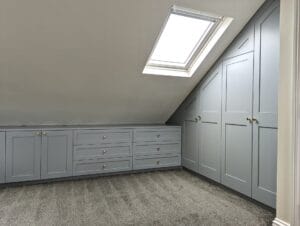
- A loft conversion, where storage often sits against the coldest surfaces in the house and doors stay shut for months at a time.
None of these rule out built-in storage. They are simply the conversations worth having before the drawings are signed off.
Questions worth asking at your design visit
Perhaps the most meaningful trend of all is a move toward mindful, lasting choices. With more thought going into every purchase, people are choosing fewer, better pieces designed to endure rather than furniture that will be replaced in a few years.
Made-to-measure fitted furniture suits this perfectly, since it is built specifically for your home and made to last. A hand-painted finish adds to that longevity, because it can be touched up or repainted in a fresh colour years later, letting a piece keep pace with changing tastes rather than dating. Choosing well-made furniture that lasts is, quietly, the most stylish decision of 2026.
What you control once it's fitted
The build is one half of the equation. How the room is used is the other, and it is the half most people underestimate.
Ventilate the bedroom. Opening a window properly for a short period each morning removes more moisture than any furniture decision you will make.
Never put damp clothes away. Anything still holding moisture releases it into a closed space with no airflow. This is the single most common cause of musty-smelling clothes.
Don’t dry laundry in the bedroom. It is the biggest avoidable moisture source in most homes, and it undoes everything else.
Leave the doors open now and then. Especially in a spare room nobody opens from one month to the next.
Deal with existing damp first. If a wall already has a problem, that problem needs solving before anything is built against it. Humphries only takes on new work built from the ground up and does not carry out repairs or remedial work, so the underlying issue has to be resolved by the appropriate trade beforehand. Building over a known damp patch simply hides it.
The short version
A fitted wardrobe on an external wall is not a mistake. A fitted wardrobe designed without any reference to the wall behind it might turn into one.
The difference is whether somebody measured your specific wall, in your specific room, and thought about it before anything was made — which is exactly what a proper design visit and a full 3D drawings package exist to do.
FAQs
Does a fitted wardrobe cause condensation?
No. Condensation is caused by warm, moist air meeting a cold surface where air cannot circulate. A wardrobe can contribute by removing air movement from one spot, which is why the wall behind it should be discussed at design stage.
Can you fit a built-in wardrobe against an external wall?
Yes. Because bespoke units are built to measurements taken in your own room, the wall behind is factored into the design rather than discovered afterwards.
Should I fix damp before having fitted wardrobes installed?
Yes. Humphries builds new projects from the ground up and does not carry out repairs or remedial work, so existing damp should be resolved before installation.
Do fitted wardrobes make a bedroom colder?
No. They do not change how a room is heated. What matters is airflow around the unit, which is a design consideration.
Does Humphries Cabinets cover my area?
Humphries covers all areas within the M25, working across every London borough from workshops in Finsbury Park and Charlton and an office in Kidbrooke.
Worried about a particular wall in your home? Book a free, no-obligation design visit and we’ll measure the space and talk it through with you. Call 020 8259 4871 or request a free quote.