Skip to content

What happens on fitted wardrobe installation day?
A lead carpenter arrives, protects the room with dust sheets and builds the units in place. Much of the work is done in the workshop beforehand, but fitted furniture always requires cutting on site to match your walls and floor. If you have chosen a hand-painted finish, painters return as a separate visit once the carpentry is complete. Wood grain-effect laminate units arrive fully finished and need no painting on site.
By the time installation day arrives you have had a design visit, seen your 3D drawings and signed off the details. What is left are the practical questions — and they are usually the ones people feel too polite to ask.
How long will someone be in the house? How much mess? What do I need to move? Here is the honest version.
Before the day: what is actually happening
Fitted furniture is not delivered assembled. That is rather the point of it.
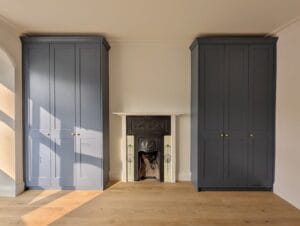
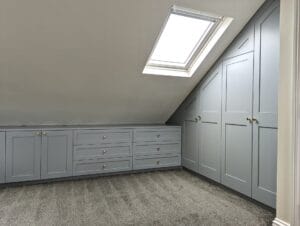
As much as possible is built in the workshop in advance. But as the About page states directly, because of the nature of fitted work there is still a lot of cutting that has to be done on site. That on-site work is exactly what allows a unit to sit flush against an uneven Victorian wall, follow the line of a sloping loft ceiling, or meet a floor that falls away towards the window. It is the difference between fitted and freestanding.
So expect a working day in your home, not a delivery slot.
Who turns up
A lead carpenter, sometimes with a second pair of hands depending on the project.
You will already have met people from the team by this point — a designer at the free design visit, and someone confirming the final details before anything went into production. Humphries puts real weight on client communication and keeping you updated as things progress, so installation day should not be the first you hear about timings.
The lead carpenters are the people the company sets most store by. Mark Booker and Jim Quere have been there since the beginning — Mark described as a total perfectionist, Jim’s artistic background evident in the work. The stated intention is that whichever lead carpenter arrives at your door, you get the same standard.
How long it takes
This depends entirely on the project, and any company quoting you a number without having seen the job is guessing.
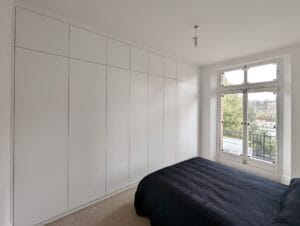
For a sense of scale, one published customer account describes a built-in floor-to-ceiling wardrobe completed by a single carpenter over two days — including building it, finishing it and clearing up afterwards. A pair of alcove units, a wall-to-wall run and a full loft fit-out are all different propositions, and your designer will give you a realistic estimate once the drawings are settled.
One thing worth planning for: start dates can move. Humphries is open about this — sometimes dates need adjusting and unexpected issues arise, and the stated approach is to keep you fully in the loop rather than leave you guessing. Allow a little slack rather than booking a carpet fitter for the following morning.
The mess question
This is what people actually want to know, and it is where the company’s own customers are most vocal.
The stated approach is straightforward: the space is protected with dust sheets and fully cleaned up afterwards.
What that has looked like in practice, in customers’ own words:
• One client noted that the fitter and painter “made sure to prepare the area well with dust sheets and plastic.”
• Another, after under-stairs work, described the carpenter cutting outside and then vacuuming the dust from the front garden — specifically to keep it out of the house.
• A third, after a wardrobe build, described the carpenter tidying and vacuuming the work area so the room was left clean.
• After living-room shelving, another wrote simply that the carpenters “were tidy and neat, left without any waste / dust.”
There will be dust. Cutting timber and board makes dust, and anyone who tells you otherwise is not doing much cutting. The difference is whether it is contained and cleared — and that is a working habit rather than a promise on a website.
What you need to do beforehand
Clear the room.
Move clothes, furniture and anything breakable out entirely. The carpenter needs working space and a clear run at the wall.
Think about the route in.
Materials and tools have to get from the van to the room. Narrow hallways, tight staircase turns, a flat with no lift — flag these at the design visit rather than on the morning.
Sort out parking.
Wardrobes, cupboards, shelves and closely related items. Internal doors, windows, flooring and partition walling are explicitly not offered. As the About page puts it, the focus on cabinetry is exactly why the company is good at it.
Lock down your decisions.
Handles, interior layout, mirror positions. If you are supplying your own handles — some customers prefer to — have them on site and ready.
Make sure other work is finished.
Plastering, electrics and any radiator moves should be complete. Humphries works alongside your electrician for internal wardrobe lighting but does not carry out electrical work.
The painting visit
If you have chosen a hand-painted finish, the carpentry finishing is not the end of the project.
Hand-painting is done in-house and happens on site once the carpenters have finished, as a separate visit — cutting in by brush, final finish laid off with a roller. It is precisely why the finish is what it is, and it means the room is committed for longer than the carpentry alone.
If you have chosen a wood grain-effect laminate, this does not apply. Those units arrive fully finished and need no further work in your home.
Worth deciding early, because it affects your schedule as much as your aesthetic.
At handover
Walk the job with the carpenter before they leave. Open and close every door and every drawer. Check the alignment along the run. Check how it meets the wall, the floor and the ceiling.
The units have soft-close hinges and drawer runners as standard, so doors and drawers should close quietly and pull themselves shut at the end of their travel. The smaller details are often what customers notice afterwards — one described discovering small rubber door stops fitted so the doors closed silently.
If something is not right, say so at handover. The company’s stated position is that it will not brush off a job as done before it really is, and that the measure is whether you are satisfied — which only works if you speak up while someone is still standing in the room.
The short version
Expect a working day, not a delivery. Expect dust, contained and cleared. Expect a separate painting visit if you have gone hand-painted. Clear the room, sort the parking, and check everything properly before the van leaves.
FAQs
How long does it take to install fitted wardrobes?
It depends on the project. One customer describes a floor-to-ceiling wardrobe built by a single carpenter over two days, including clean-up. Your designer will give a realistic estimate once the drawings are agreed.
Is fitted furniture installation messy?
There is on-site cutting, so there is dust. Humphries protects the space with dust sheets and cleans up fully afterwards.
Do I need to empty the room first?
Yes. Clear clothes, furniture and breakables so the carpenter has clear working space.
Is the painting done on the same visit?
No. Hand-painting is a separate visit after the carpentry is complete. Wood grain-effect laminate units arrive fully finished and need no on-site painting.
Do you do the electrical work for wardrobe lighting?
No. Humphries works alongside your electrician to add internal LED lighting but does not carry out electrical work.
Will I see the design before it's built?
Yes. A full 3D drawings package is produced after the free design visit, and nothing goes into production until you have approved it.
Want the guarantee terms alongside your quote? Book a free, no-obligation design visit. Call 020 8259 4871 or request a free quote.