Skip to content

PAX suits renters, short term owners, tight budgets, and rooms with standard dimensions. Bespoke fitted wardrobes suit long term owners, irregular London rooms with alcoves or chimney breasts, tall period ceilings, and homes where storage capacity and design integration matter. Both are legitimate choices for different circumstances.
The IKEA PAX system has become the default reference point in London wardrobe decisions. Almost every prospect considering fitted wardrobes encounters PAX during their research, and many use PAX pricing as the mental benchmark against which every other option gets compared. This is understandable. PAX is widely available and produces wardrobes that look reasonable at a price point that appears attractive relative to fitted alternatives.
The comparison between PAX and bespoke fitted wardrobes deserves an honest treatment rather than dismissive treatment from either side. PAX works well for specific circumstances. Fitted wardrobes work well for different circumstances. This guide covers what actually separates the two options in practical use, and how London homeowners can make an informed decision based on their specific situation.
Where PAX Actually Works
PAX has real strengths that its designers built into the system.
Predictable pricing with clear costs before purchase. The price you see online or in store is the price you pay. This differs from custom quoting where the final price depends on the finished design.
Fast availability with delivery in days. PAX components are held in stock and can be at your home within a week. Fitted wardrobes typically involve six to twelve weeks between commissioning and installation.
Self assembly option for households with the time and inclination. This removes installation labour costs from the total investment.
Modular reconfiguration where internal fittings can be moved as needs change. Rails, shelves, and drawer inserts can be repositioned within the PAX carcass.
Straightforward removal at the end of the wardrobe’s useful life. PAX can be dismantled, moved, or discarded through standard flat pack channels rather than requiring the demolition that fitted furniture involves.
Where PAX Struggles in London Homes
PAX also has limitations that matter more in London properties than in the newer, more regular homes it was designed for.
Standard dimensions rarely match London room dimensions. PAX comes in fixed widths and heights that leave gaps against walls and ceilings. Filler panels can address this but produce a less integrated result than fitted furniture.
Ceiling height limits stop at approximately 236cm. Most London bedrooms have ceilings between 240cm and 280cm. The space above the wardrobe becomes dead space, and top boxes look visibly joined rather than seamless.
Wall irregularities cause problems for standard PAX carcasses. Period London walls are rarely straight, plumb, or level. Fitted furniture can be scribed to match wall irregularities. PAX cannot.
Alcove accommodation is poor. PAX standard sizes rarely fit chimney breast alcoves or the irregular spaces that period London rooms present. The system was designed for regular rooms with straight walls.
Longevity under heavy use is limited. PAX handles moderate daily use adequately but shows meaningful wear within seven to ten years. Under heavy use, replacement is often needed within fifteen years.
Visual quality at close range shows the mass production origins. Edge banding and detailed work reveal the price point when examined closely. This matters more in bedrooms where the wardrobe is seen daily at close range.
Where Fitted Wardrobes Actually Excel
Fitted furniture has strengths that PAX cannot match regardless of configuration.
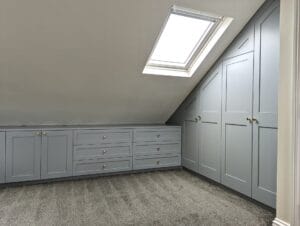
Perfect fit to the specific room including full ceiling height, exact wall to wall dimensions, and accommodation of all irregular features. Every gap is eliminated, every wall irregularity is scribed to, and every centimetre of available space becomes usable storage.
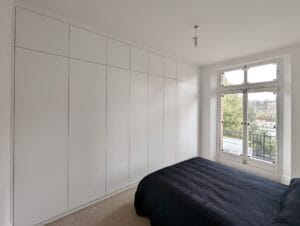
Full ceiling height use captures the volume between the top of standard PAX and the actual ceiling. In a room with 270cm ceilings, this represents 14% additional storage capacity in the same footprint.
Design integration with the room, including finishes that coordinate with existing decor, panel details that reference other features, and proportions designed for the specific space.
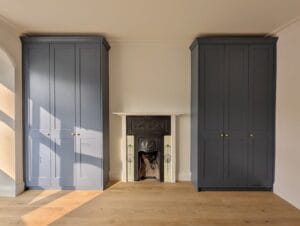
Alcove and irregular space use with fitted furniture designed around chimney breasts, angled walls, and awkward corners.
Material quality appropriate to the specific project. Properly finished MDF or solid timber, proper joinery, and hardware chosen for the specific specification.
Longevity across decades with fitted furniture that typically lasts twenty five to fifty years with appropriate care. This significantly changes the true cost calculation.
The Real Cost Comparison
Direct pricing comparison usually favours PAX. A fully specified PAX installation for a typical London bedroom might cost £1,500 to £3,000. Comparable fitted furniture might cost £4,000 to £12,000 depending on specification.
This direct comparison is misleading in three ways.
Storage capacity is not equivalent.
Fitted furniture typically captures 15 to 30 percent more usable storage than PAX in the same room. This comes from filling ceiling height that PAX leaves unused, scribing into wall irregularities that PAX has to leave as gaps, and using the full wall width without the end panel gaps that modular systems require. Comparing pounds per unit of actual storage capacity narrows the gap significantly.
Longevity is not equivalent.
PAX under heavy use often needs replacement within 15 years as cam and dowel joints loosen, laminate edges chip, and hinges lose their spring. Well built fitted furniture typically lasts 25 to 50 years because it uses screwed and glued construction, quality hardware from named brands, and finishes that can be refreshed rather than replaced. Cost amortised across expected lifespan changes the calculation considerably.
Property value impact differs
Well designed fitted furniture in appropriate homes typically contributes to property value at sale. Estate agents mention fitted furniture in listings, particularly in master bedrooms. PAX generally does not contribute to property value and may be perceived by buyers as furniture to remove rather than an asset to inherit with the property.
Who Should Choose Which
Some households will be better served by PAX regardless of budget.
Renters in properties where fitted installation is not permitted.
Short term owners planning to move within three to five years.
Regular room configurations where the specific advantages of fitted furniture are less relevant.
Extreme budget constraints where the additional investment cannot be justified against other priorities.
Other households will be better served by fitted furniture.
Long term owners where the wardrobe will serve the household for a decade or more.
Irregular rooms with alcoves, chimney breasts, angled walls, or unusual dimensions.
Tall ceilings where the storage volume above standard PAX height represents meaningful additional capacity.
Period properties where the wardrobe must work with existing architecture rather than sit awkwardly against it.
Homes intended for long term ownership where the wardrobe’s design contribution to the room matters day to day.
FAQs
How long do IKEA PAX wardrobes actually last?
PAX under moderate use typically shows meaningful wear within seven to ten years. Under heavy daily use, replacement is often needed within fifteen years. Individual components can be replaced without full replacement. Fitted furniture typically lasts twenty five to fifty years with appropriate care.
Can custom doors be fitted to an IKEA PAX carcass?
Yes, this hybrid approach has become popular. Custom doors from third party suppliers can transform PAX carcasses into installations that look more premium. The trade off is the added cost that narrows the price gap with fitted furniture while still keeping PAX limitations on ceiling height and wall fit.
Do fitted wardrobes add value to a London home?
Well designed fitted wardrobes in appropriate homes typically contribute to property value. Estate agents mention fitted furniture in listings, particularly in master bedrooms. PAX generally does not contribute to property value and may be perceived by buyers as furniture to remove rather than an asset to inherit.
Is the price difference between PAX and fitted wardrobes justified?
It depends on the situation. For long term owners in irregular London rooms, fitted wardrobes typically justify the investment through better use of space, longer lifespan, and property value contribution. For short term owners or standard rooms, PAX often represents better value.
What Humphries Cabinets Offers
We design and install fitted wardrobes across London for homeowners who have concluded that fitted furniture suits their specific situation. Our services include:
• Bespoke Fitted Wardrobes designed and built for the specific room, household, and use pattern
• Floor to Ceiling Wardrobes capturing full room height that modular systems cannot
• Modern Fitted Wardrobes with contemporary design and hardware
• Shaker Style Wardrobes in traditional designs for period properties
• Wardrobe Interiors configured to specific storage requirements
• Sliding Door Wardrobes for rooms where floor space matters
Every project starts with a free design visit that establishes whether fitted furniture is the appropriate choice for your specific situation.
Why Choose Humphries Cabinets
At Humphries Cabinets, we approach the fitted versus flat pack question honestly. Fitted furniture is not universally better than modular alternatives. It is the right choice for specific circumstances and the wrong choice for others. Where fitted furniture is the right choice for your home, we build it properly and back it with our 15 year guarantee.
If you are considering fitted wardrobes for your London property and want to discuss whether this is the right approach for your specific circumstances, contact us today to arrange your free consultation.